
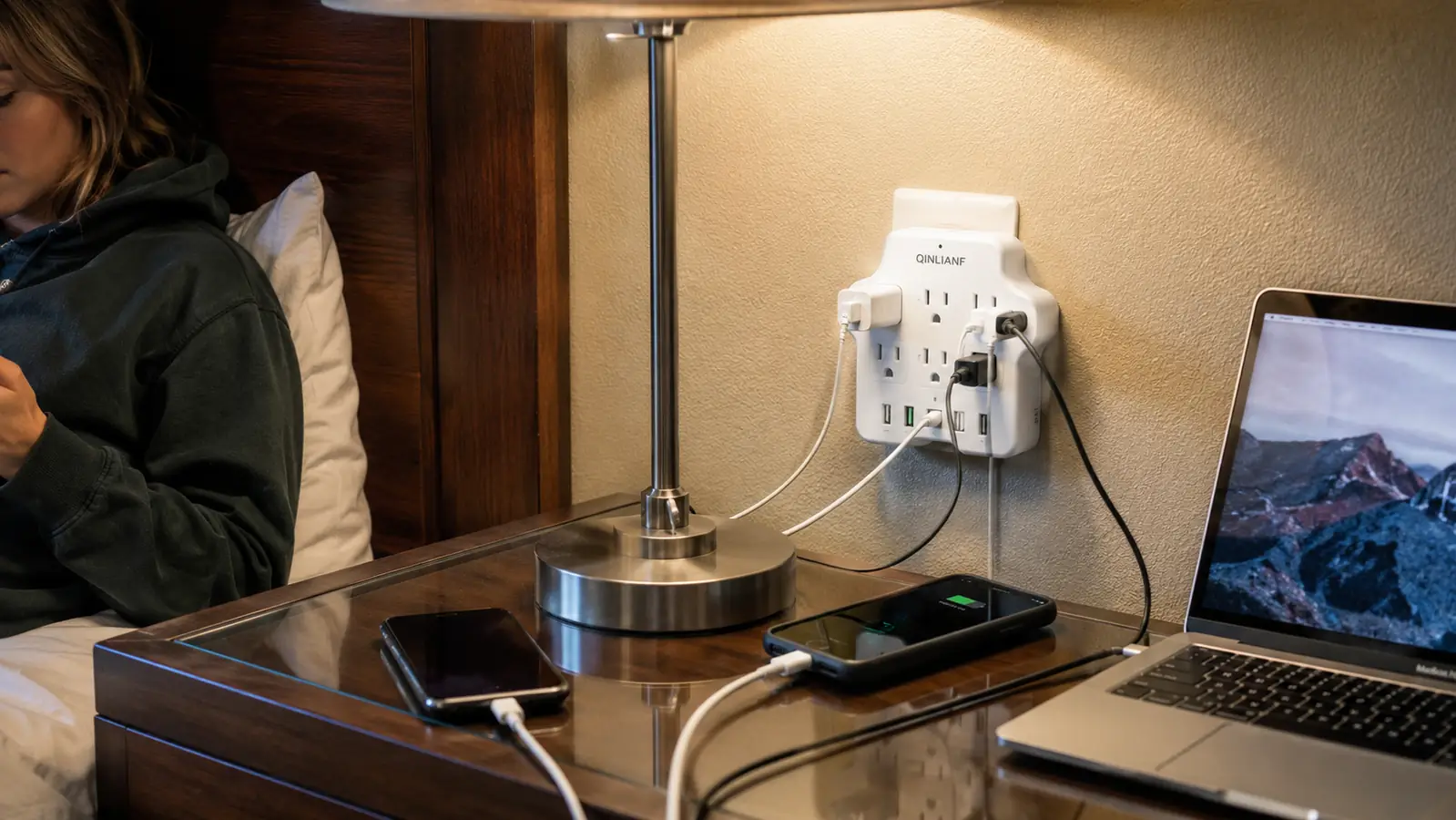
I started traveling with the QINLIANF power strip a little over a year ago, after one too many hotel rooms where the only outlet in reach was a single two-prong plug wedged behind a nightstand that also had to run the lamp. My wife Rennie and I travel enough between flights and long stretches on the road in our 2018 4Runner that charging has become its own small logistics problem: two phones, a laptop, a tablet, sometimes a portable speaker, and never more than one or two outlets that are actually easy to reach without moving furniture. This strip has five AC outlets and four USB ports built into one block, and it has been in my carry-on or my center console for something like fourteen months now.
This is not a first-impressions review. I have used this strip in roadside motels, business hotels, an Airbnb with exactly one working outlet in the whole bedroom, and more than a few gas station stops where I just needed to top off a phone while Rennie ran into the store. What follows is what happened to the outlets, the USB ports, and the cord over that stretch, including the two things that have genuinely worn down and the one thing I would tell anyone to check before they ever plug it in overseas.
The Quick Verdict
A genuinely useful hotel-room fix for too few outlets, with real simultaneous charging speed and a design that has held up to a year of daily plugging and unplugging, though it runs warmer than I expected under a full load and it is not, and never will be, a voltage converter.
Amazon Check Today's Price →Tired of Hotel Rooms With One Outlet and Four Things to Charge?
This strip turns one hotel outlet into five plus four USB ports, and after a year of near-daily use, none of them have failed on me.
Amazon Check Today's Price on Amazon →How I've Used It Over the Past Year
The QINLIANF lives in the outer pocket of my carry-on when I fly and in the center console of the 4Runner when we drive, seeing roughly forty hotel nights and double that many gas station charging stops over the last fourteen months. On the road it usually runs off a 12V-to-AC inverter for a quick top-off during a driving break, so that use has been lighter on it than the hotel use has.
The hotel use is where it earns its keep. Most of the rooms Rennie and I have stayed in over the past year have somewhere between one and three outlets that are actually reachable without dragging furniture, and at least half of those rooms had at least one outlet already occupied by a lamp or an alarm clock. I plug the strip into whatever outlet is free, and from there I can run both our phones, my laptop, and her tablet off one wall connection instead of hunting for a second outlet across the room or under the bed.
It has also become the thing I hand Rennie when she needs to charge something and I do not, since the three-sided outlet layout means we are not fighting over which plug blocks which. If you are trying to decide whether a strip like this is worth packing at all versus just bringing a couple of plug adapters, I laid out the actual differences in power strip versus travel adapter, since they solve two different problems and people often assume they are interchangeable.
Port Count and Real Simultaneous Charging Speed
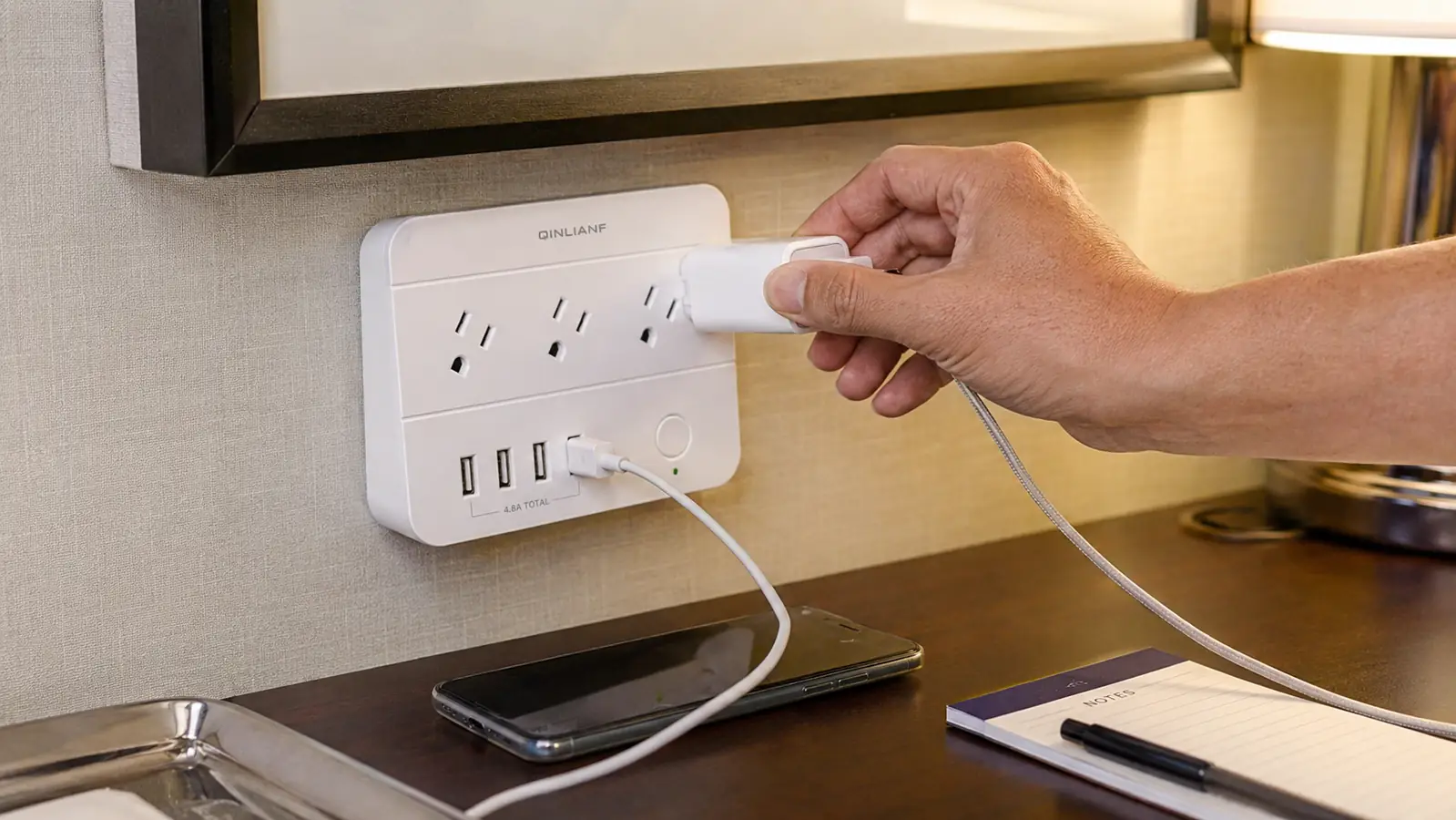
Five AC outlets and four USB-A ports sounds like a lot on the box, and in practice it has been enough that Rennie and I have never once had to unplug something to plug in something else, even on nights when we were both charging phones, I had the laptop on the desk, and a battery pack was topping off on the nightstand at the same time. The three-sided layout spaces the AC outlets out and angles them so that a bulky laptop brick does not block the two outlets next to it, which is the single biggest daily annoyance I remember from the flat power strips I used before this one.
The four USB ports share a combined output rather than each running at its own fastest speed, so charging one phone alone gets close to a full charge in the time I would expect from a wall adapter. Add a second phone and a tablet, and each device charges roughly a third to a half slower by my rough timing over several nights, though none of them charge so slowly it has ever been a real problem overnight. If you need one device charged as fast as possible, a lone wall outlet beats this strip's USB ports every time. If you need four things charged by morning, it gets there.
Cord Length Versus Awkward Hotel Outlet Placement
The cord runs about five feet from plug to block, which sounds generous until you actually meet a hotel room where the only free outlet is behind a heavy dresser on the far wall and the nightstand you actually want to use is six feet away. Most nights, five feet has been plenty to reach from a wall outlet to a nightstand or a desk without stretching. I would put it at three or four nights out of every ten where the outlet placement was awkward enough that I had to rearrange a lamp cord or set the strip on the floor near the outlet instead of up on the nightstand where I actually wanted it.
The flat plug helps more than I expected going in. A lot of the outlets I have plugged this into over the past year sit low behind furniture, and a bulky right-angle or vertical plug would not have cleared the gap behind a dresser the way this flat one does. That said, five feet is a fixed number, and if your habit is always plugging in from across the room rather than right next to the bed, I would measure your own worst-case hotel outlet distance before assuming this cord reaches. It has been enough for me and Rennie's usual setup, but it is not an extension cord, and I would not buy it expecting it to be one.
Packed Size and Weight in the Bag
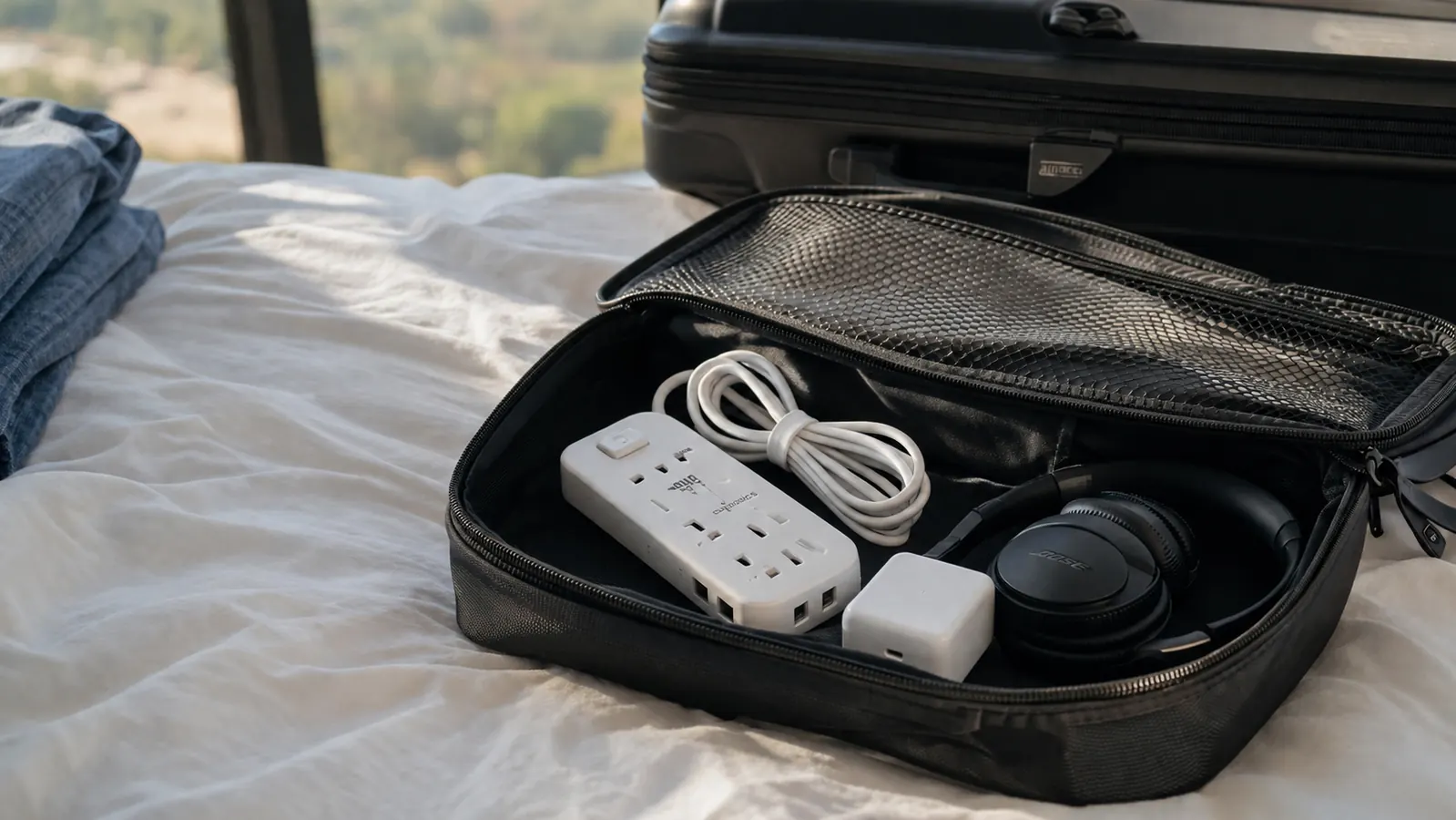
On my kitchen scale, the strip alone comes in right around 13 ounces, and with the cord coiled it takes up roughly the space of a stacked deck of playing cards standing on end, about 6.7 inches long, 3 inches wide, and a little over an inch thick. That is small enough that it has never been the reason my carry-on felt heavy, and I have carried it in the outer pocket of a backpack more often than in a packing cube, since it holds its shape well enough that I do not worry about it getting crushed by clothes packed on top of it.
The one packing annoyance is the cord itself. It is flat rather than round, which makes it resist tangling with itself, but it does not coil into a tidy loop the way a round cord does, so it tends to hold whatever shape you last bent it into. I keep mine in a small mesh pouch with a phone charger and a pair of earbuds now, which solved the loose-cord-tangling-with-everything-else problem I had the first couple of months when it just floated free in my bag.
Heat Under Sustained Load
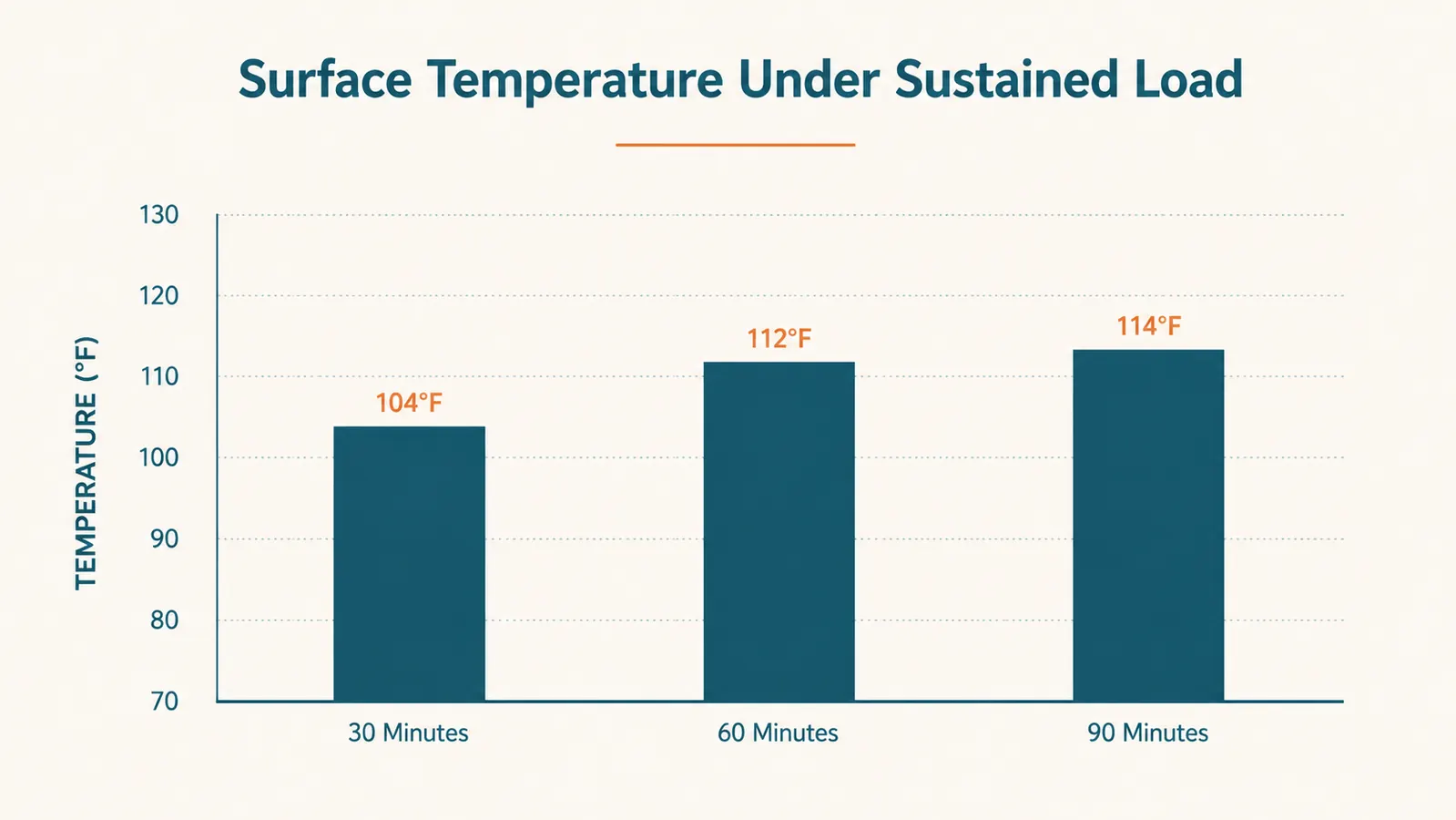
This is the part of the review that surprised me. On a night where I had the laptop charging, both our phones on USB, and a small travel fan plugged into one of the AC outlets, I touched the strip about ninety minutes in and it was warmer than I expected, noticeably warm to the touch on the top surface near the outlets that were actually in use, though not hot enough that I was worried about it. I started paying attention after that and found the pattern is consistent: light loads, one or two devices, barely warm at all. A full load with every outlet and USB port doing something, and it climbs to a warm-but-tolerable temperature within the first half hour and holds roughly steady from there rather than continuing to climb.
I have not had it get hot enough to smell anything or trip its own protection, and the 1680 joule surge rating on the spec sheet suggests it is built to handle spikes rather than just steady draw, but I do not run a hair dryer or anything heat-generating off this strip anymore, and I would tell anyone else not to either. It is rated for a combined load in the range you would expect from a strip like this, and I keep my actual use well under that by avoiding anything that pulls serious wattage, space heaters, hair dryers, or clothes irons included. Phones, laptops, tablets, and small electronics is what it is built for, and that is what I use it for.
Voltage Abroad: What This Strip Can and Cannot Do
This is the single most important thing I can tell you about this strip, and it applies to almost every US travel power strip like it, not just this one. This is a surge-protected outlet extender built for 110 to 120 volt US power. It is not a voltage converter, and plugging a strip like this into a 220 to 240 volt outlet in most of Europe, the UK, Australia, or a large part of Asia and Africa, even with a plug-shape adapter that lets the prongs physically fit, can destroy the strip and anything plugged into it. A plug adapter changes the shape of the prongs. It does nothing to change the voltage running through them.
Most modern phone chargers, laptop bricks, and camera chargers are dual voltage, meaning the small print will say something like 100 to 240 volts, and those devices are genuinely fine with a plug adapter alone. High-wattage devices are usually a different story. Hair dryers, curling irons, and travel kettles are frequently built for one voltage only, and running one off a US strip through an adapter is how people burn out both the appliance and the strip in one go. Before traveling internationally, read the voltage marking printed on every device. If it does not say a range like 100 to 240 volts, do not assume an adapter alone makes it safe.
Two more things worth knowing. First, the total draw across everything plugged in at once needs to stay within the strip's rated capacity, one more reason I have stopped running anything heat-generating off it. Second, some hotels and most cruise lines explicitly prohibit surge protectors and multi-outlet strips in guest rooms and cabins for fire safety reasons, and mine has been asked about at check-in more than once. I always check the specific policy before packing it for that kind of trip. None of this is professional electrical advice, just what a year of using one of these has taught me.
What I Liked
- Five AC outlets spaced and angled so bulky plugs do not block their neighbors
- Four USB ports have handled charging two phones and a tablet at once without ever forcing us to unplug something
- Compact and light enough at 13 ounces that it has never been the reason a bag felt heavy
- Flat plug clears low, hard-to-reach outlets behind furniture better than a bulky plug would
- No outlet or USB port has failed after roughly fourteen months of near-daily hotel use
Where It Falls Short
- Runs noticeably warm to the touch under a genuinely full load of every port in use
- USB charging speed drops when multiple devices share the ports at once
- Five-foot cord comes up short in a handful of hotel rooms with awkward outlet placement
- Flat cord resists tangling with itself but does not coil neatly for packing
- Is not a voltage converter, and treating it like one abroad can ruin the strip and whatever is plugged into it
A plug adapter changes the shape of the prongs. It does nothing to change the voltage running through them, and that distinction matters more than almost anything else in this review.
Who This Is For
If you travel domestically and regularly find yourself in hotel rooms with too few reachable outlets for how many things you and a travel partner need to charge, the QINLIANF has done exactly that job for me for over a year without a single outlet or USB port failing. It is small enough to pack without a second thought and genuinely solves the one-outlet-two-people problem that used to mean someone was always waiting to charge their phone. For a broader look at why this kind of gear earns a permanent spot in a travel bag rather than staying home most trips, our piece on why a power strip is a hotel room essential covers the rest of the case.
Who Should Skip It
Skip this one if you are traveling internationally and thinking of it as a way to run US appliances abroad, because it is not built for that job and treating it that way risks the strip, your charger, and whatever else is connected. I would also skip it if you are only ever charging one device at a time and traveling solo, since a single wall adapter or a basic dual-USB plug will do that job lighter and smaller than this strip does. And if you are booking a cruise or a hotel with a known no-surge-protector policy, check before you pack it rather than finding out at check-in the way I did once.
A Year of Hotel Rooms Later, It's Still the First Thing I Pack
No failed outlets, no dead USB ports, just steady, warm-but-safe charging for two people's worth of devices off one outlet. If you're tired of hunting for a second plug in every hotel room, this is worth a look.
Amazon Check Today's Price on Amazon →