
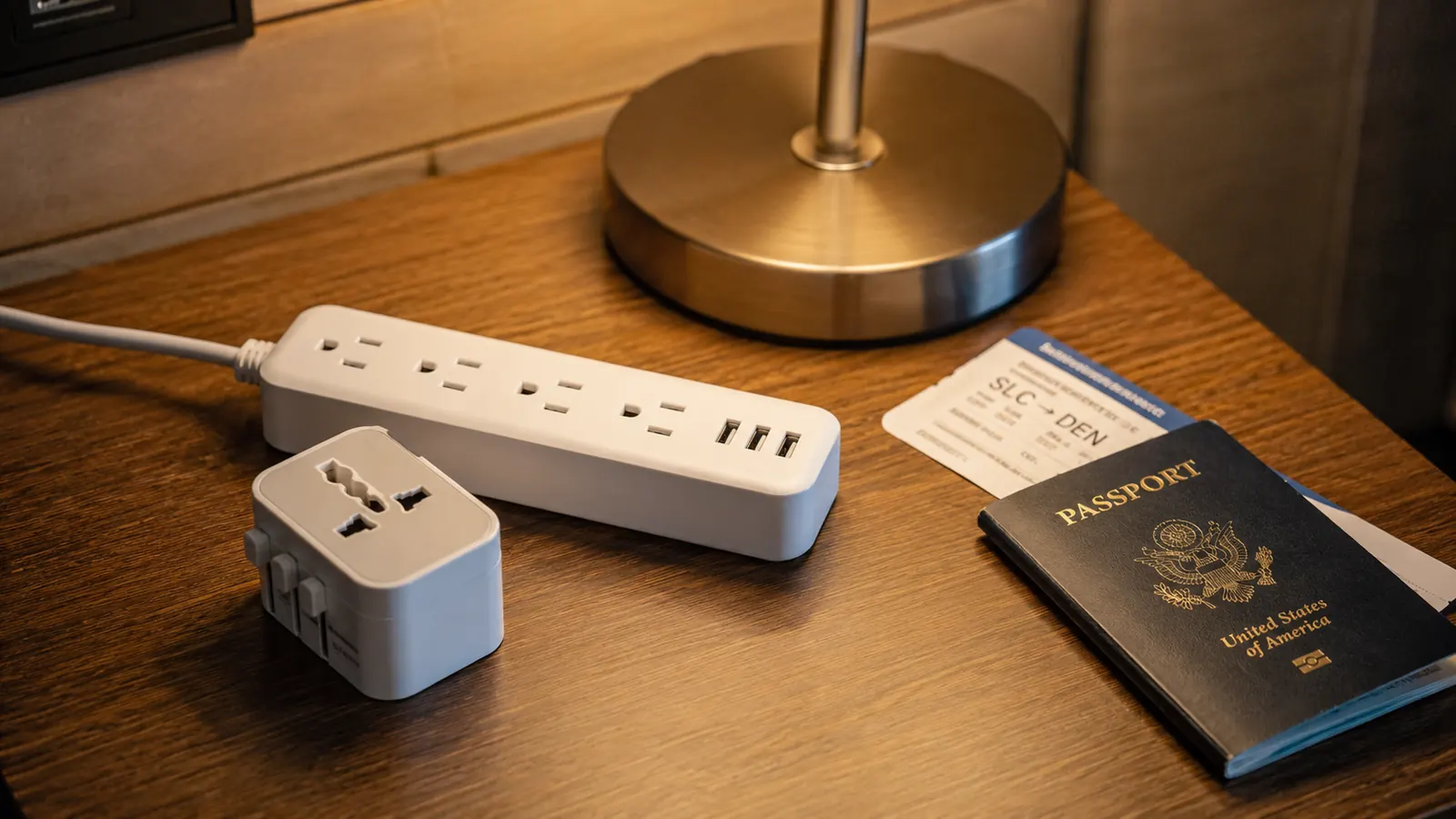
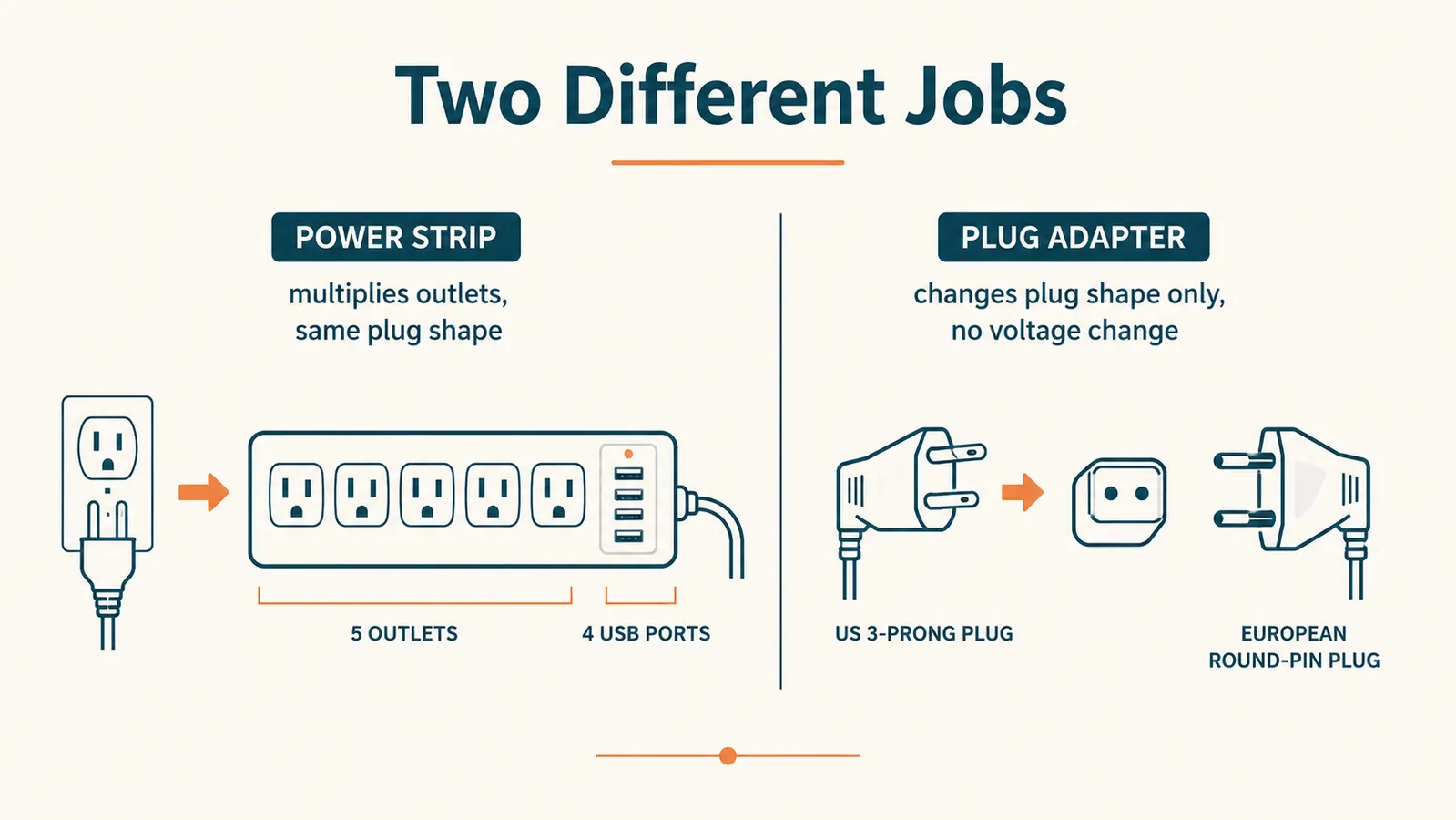
The short answer is that a travel power strip and a plug adapter are not fighting over the same job, and mixing them up is the single most common mistake I watch people make right before a trip. A power strip like the QINLIANF multiplies the outlets you already have, turning one wall socket into five AC outlets and four USB ports. A plug adapter does something entirely different: it changes the physical shape of the plug so it can fit into a foreign country's wall socket. Neither device changes the voltage coming out of that wall. If you take one thing from this article, take that distinction, because it is the difference between a smooth trip and a fried phone charger.
My wife Rennie and I have carried both of these through more hotel rooms and airport gates than I can count, whether we are three days into a stretch of the 4Runner through mountain towns or flying out of Boise for a week somewhere. The QINLIANF power strip lives in our road trip bag because most hotel rooms, even decent ones, still only give you two working outlets, usually hidden behind a lamp on one nightstand, and between two phones, a tablet, a laptop, and a camera battery charger, that is never enough. The plug adapter only comes out when we are leaving the country, and it lives in a completely separate pouch, because grabbing the wrong tool for the wrong outlet is exactly how gear gets damaged.
| QINLIANF Travel Power Strip | Plug Shape Adapter | |
|---|---|---|
| What it actually does | Multiplies one wall outlet into more usable outlets and USB ports | Changes the shape of the plug so it physically fits a different country's socket |
| Devices powered at once | 5 AC outlets plus 4 USB-A ports, up to 9 devices from a single wall socket | Typically passes through 1 outlet at a time, a few multi-country versions add 1 or 2 USB ports |
| Plug-shape conversion | None, keeps the same 3-prong US plug shape going in and coming out | Yes, this is its entire purpose, swaps between US, UK, EU, and AU/China blade shapes |
| Voltage conversion | None, does not step voltage up or down in either direction | None either, despite what a lot of buyers assume when they first see it |
| Packed size and weight | About the size of a paperback, roughly 7 by 3 inches, heavier because of the internal surge protection | Palm sized, often under 3 ounces, small enough to lose at the bottom of a bag |
| Needed for international travel | Only if the destination's outlets already accept a US-shaped 3-prong plug, otherwise it needs an adapter plugged in ahead of it | Required any time the wall socket shape differs from home, this is the item that actually gets you connected abroad |
| Surge protection | 1680 joules of surge protection covering every device plugged into it | None, most adapters are a simple mechanical shape converter with no circuitry inside at all |
| Risk if used incorrectly | Low at home, but feeding a US-rated strip 220-240V power abroad can destroy the strip and every device plugged into it | Low, worst case a plug simply does not fit and nothing powers on |
| Best use case | Hotel rooms, Airbnbs, RVs, and work desks domestically where there are never enough outlets | Any international trip where the wall socket shape is different from home |
How These Two Actually Solve Different Problems
It helps to picture what happens right at the wall. A power strip is a pass-through multiplier. Whatever comes out of the outlet, 120 volts in a typical US wall, runs through the strip completely unchanged and gets divided across more plug points and USB ports. A plug adapter never touches the electricity at all. It just lets a US-shaped 3-prong plug physically seat into a socket shaped for round European pins, angled UK pins, or slanted Australian blades. Neither one is a voltage converter, and that catches people out constantly. A dedicated voltage converter is a separate, much heavier piece of equipment, and most travelers do not actually need one, for a reason that has more to do with your chargers than the wall.
Here is the part that actually matters for what you pack. Most laptop and phone chargers built in the last several years are dual voltage, meaning the charging brick itself is rated for something like 100 to 240 volts, and you can confirm this by reading the fine print stamped right on the charger before any trip. Plug one of those into a plug adapter for the shape and it runs fine on a 230V European outlet with no converter needed. Hair dryers, curling irons, and other high-wattage heat appliances usually are not dual voltage. They are usually built for one voltage range only, and running one on the wrong voltage does not just underperform, it can burn out the heating element or, in a worse case, start smoking within minutes. That is the item to think twice about packing, not your phone charger.
Where the QINLIANF Power Strip Wins
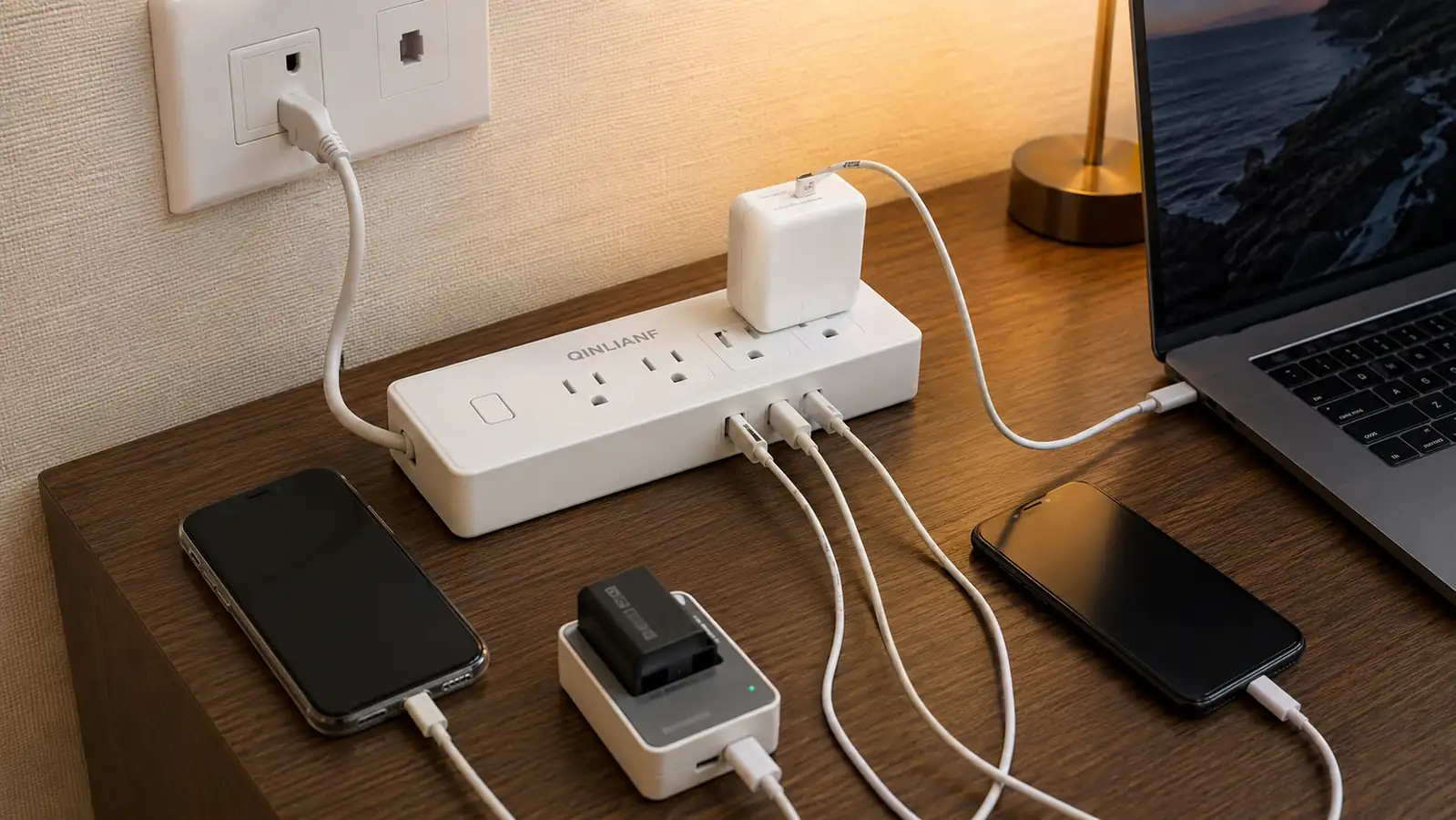
For domestic travel, the QINLIANF earns its space in the bag almost every trip. Older motels and even newer hotel rooms routinely put two outlets behind a heavy nightstand and call it done, and that is nowhere near enough once you count Rennie's phone, my phone, a tablet for the evening, and a camera battery charger that all need power overnight. I plug the strip in once, and everything charges from that single accessible outlet instead of a game of musical chairs where somebody's phone dies at 40 percent because the outlet was needed for something else. The three-sided plug spacing on this one also matters more than it sounds like it should, since it fits bulky wall bricks without one blocking the outlet next to it, which is a real problem on cheaper strips I've used in the past.
The 1680 joule surge protection is the other piece I would not want to travel without, especially in older buildings where I genuinely do not know what the wiring behind that outlet looks like. It is not a feature you notice day to day, but it is the kind of thing that matters exactly once, and I would rather have it built in than find out the hard way. I get into how the strip has actually held up over months of regular use, including the one part that started to wear sooner than I expected, in my long-term QINLIANF review.
Where the Plug Adapter Wins
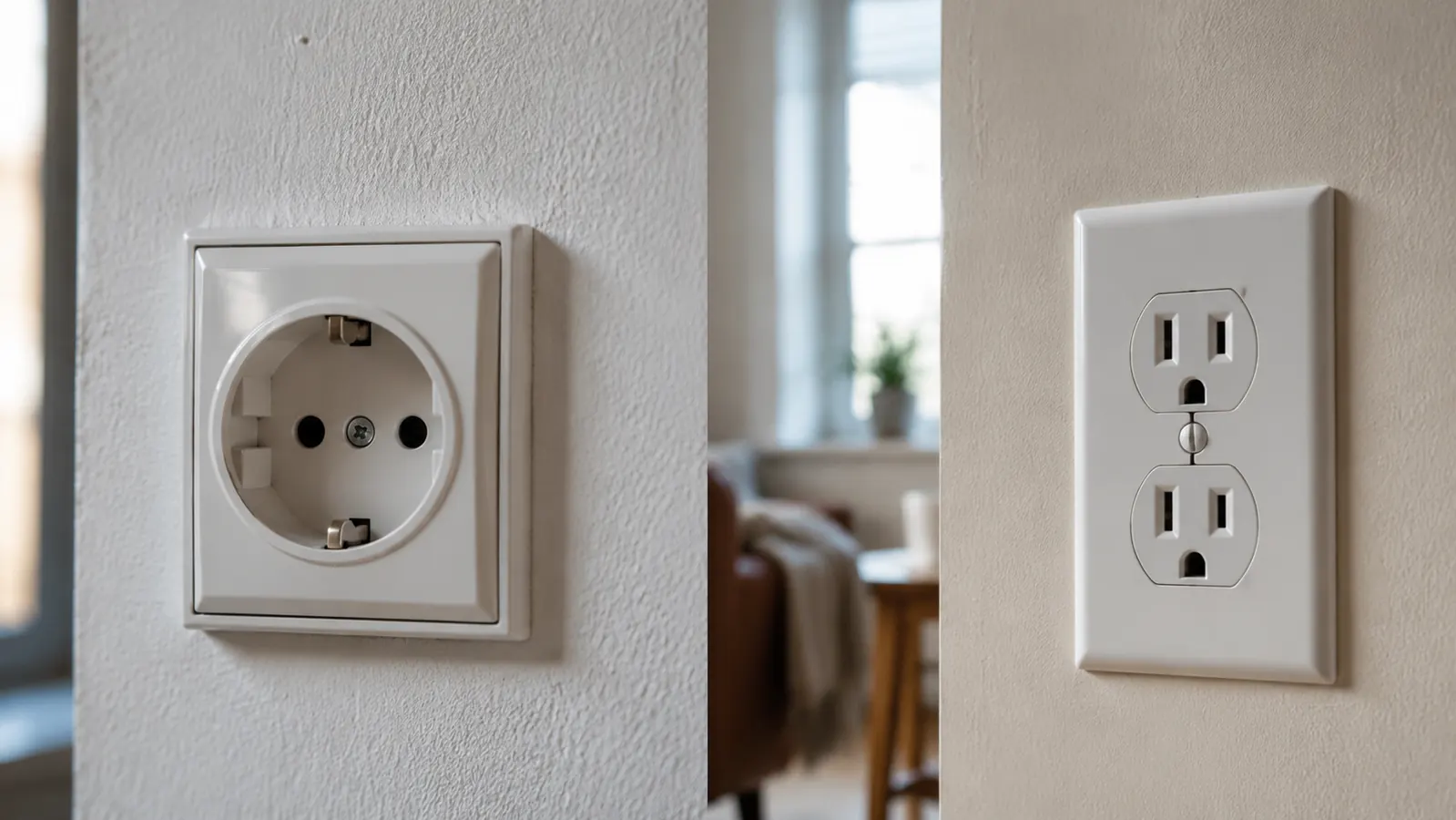
Abroad, the plug adapter is not optional. If the wall socket in your hotel room is shaped for round European pins and every charger you own ends in a flat US 3-prong plug, nothing you pack matters until you solve that shape mismatch first. This is the item that actually gets your devices connected to the wall, full stop, and it is worth throwing an extra one in your bag since they are small enough to lose track of and cheap enough that a spare does not add real weight.
Where the adapter falls short is the exact thing the power strip is good at. A single plug adapter still only gives you one outlet on the other side, so if you and a travel partner both need to charge phones plus a laptop plus a tablet overnight, one adapter alone forces the same outlet-sharing problem you'd have at a domestic hotel, just with an extra shape-conversion step involved. That is usually the moment travelers realize they actually needed both pieces of gear, not just the one they remembered to pack.
Tired of unplugging your phone charger every time your laptop needs the outlet?
The QINLIANF turns one hotel outlet into five plus four USB ports, with 1680 joules of surge protection built in. See today's price on Amazon.
Amazon Check Today's Price on Amazon →The Voltage Mistake That Can Destroy Both
This is the warning I give anyone who borrows our travel bag before an international trip. The QINLIANF, like most power strips sold in the US, is built and rated for 120 volt US household current. If you plug it into a 220-240V outlet abroad, even through a plug adapter that makes the shape fit, you are feeding it roughly double the voltage it was built for, and there is no fuse trick or workaround that saves it. The strip itself can fail, and worse, it can pass that higher voltage straight through to whatever is plugged into it, which puts every device connected to the strip at risk, not just the strip. This is general guidance based on how these devices are built, not electrical or professional advice, and when in doubt about a specific outlet or country's voltage, check before you plug anything in.
There is also a policy wrinkle worth knowing before you pack either item. Some hotels post signs discouraging personal power strips, and most cruise lines explicitly prohibit multi-outlet strips and surge protectors of any kind onboard, citing fire code, confiscating them at the gangway if they turn up in a bag search. A single plug adapter with no outlet multiplication is normally still permitted on a cruise. If a cruise is anywhere on your itinerary, check that specific line's current policy before you pack the QINLIANF, since a rule you did not know about is a worse surprise at boarding than an outlet you have to share.
When You Actually Need Both
The trips where both pieces of gear earn their spot are the international ones where you also want the multi-device convenience of home. The sequence that works, and the only sequence I'd suggest, is plugging the adapter into the foreign wall first to solve the shape mismatch, then plugging a US-rated strip into that adapter only if you have separately confirmed the destination outlet is 120V or that every single device on the strip is genuinely dual voltage. Most of Japan and parts of North America run close to 120V, which is why this combination is more common on some routes than others. When that check has not been done, skip the strip entirely and just use individual adapters on each charger instead. It is slower, but it does not risk the gear.
Who Should Buy Which
If most of your travel is domestic, road trips in the 4Runner, weekend flights, hotel stays where two outlets never seem to be enough, the QINLIANF is the tool that solves a problem you run into on nearly every trip. If international travel is on the calendar, the plug adapter is not a nice-to-have, it is the item that determines whether anything charges at all, and it belongs in your bag before the strip does. For a trip that is both, pack the adapter as the non-negotiable item and add the strip only once you've checked the voltage math for that specific destination. I cover the one thing about the QINLIANF that surprised me most after months of actual use, including where it started to show wear, in my honest QINLIANF review.
Know which outlets you're dealing with, then fix the one that's actually a problem at home.
See current availability and pricing for the QINLIANF power strip before your next hotel stay or road trip.
Amazon Check Today's Price on Amazon →