
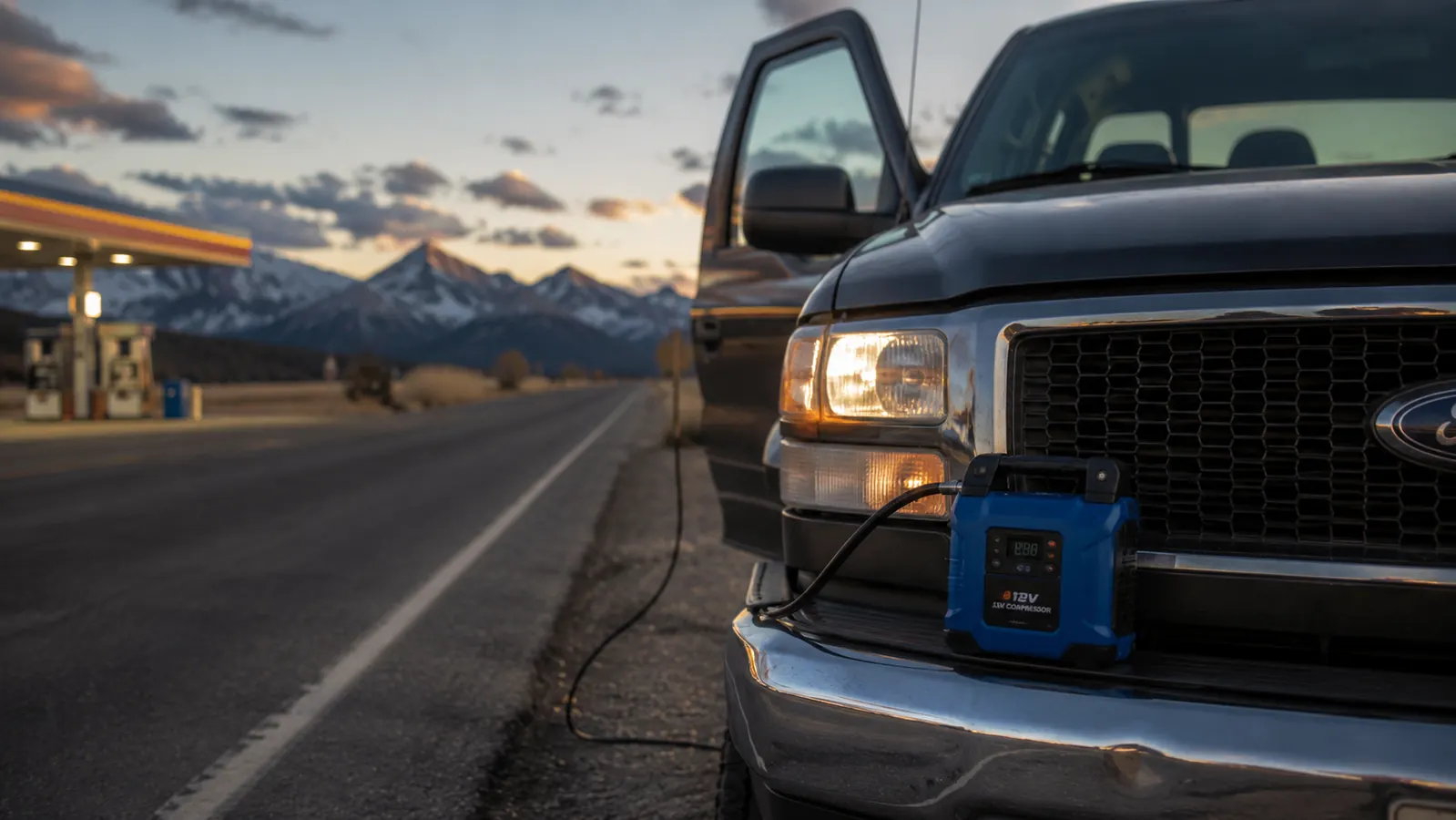
Short answer: the AstroAI 12V inflator wins for anyone who drives long distances, because it works wherever your truck is parked, whatever time it is, and it tells you the actual number instead of making you guess. The gas station pump wins in exactly one situation, when a tire is fully flat and you need a lot of air fast. I keep both facts in my head because I have needed both kinds of air on different trips, and pretending one tool replaces the other in every case would be dishonest.
My wife Rennie and I put about 9,000 miles a year on our 2018 4Runner, mostly two-lane highways between Boise and wherever we are headed that season. I started carrying the AstroAI after a night outside Winnemucca where the only working air pump within 40 miles was out of order, and I had a tire reading 22 PSI on a cold morning with 300 miles still to go. That is the trip that changed how I think about tire pressure entirely, and it is the reason I now check pressure before I need to, not after a dash light comes on.
| AstroAI Portable Inflator | Gas Station Air Pump | |
|---|---|---|
| Availability at night or in bad weather | Works anywhere you can park, any hour, any weather, since it plugs into your own 12V outlet | Depends on the station being open and the pump not being broken, out of order signs are common after dark |
| Gauge accuracy | Digital readout to the whole PSI, I've checked mine against a separate gauge and it stays within 1 PSI | Analog dial, often dented or stuck, several I've used read 4 to 6 PSI off from a real gauge |
| Cost per use | One-time purchase, no per-visit charge ever again | Coin-operated at most stations I've used, and a few now charge more than they used to for the same 4 minutes of air |
| Speed to fill one tire from 20 to 35 PSI | About 2 to 3 minutes per tire on a passenger tire | Usually faster, under a minute, when the pump is working at full pressure and hasn't timed out yet |
| Works on a roadside shoulder | Yes, plugs straight into the vehicle, no need to find a station or pull off your route | No, you have to drive to a station, which is not an option if a tire is already too low to drive on safely |
| Raw airflow for a fully flat tire | Slower, built for topping off, not for reinflating a tire that lost all its air | Wins here, a shop compressor or station pump moves far more air per minute for a truly flat tire |
| Auto shut-off to your target PSI | Yes, set the number and it stops on its own | No, you watch the dial and pull the trigger yourself, easy to overshoot |
| Physical wear over repeated use | Cord and hose show use but the pump motor itself has held up over regular checks | Public hoses crack, nozzles leak air, and I've had two different stations' pumps simply stop building pressure mid-fill |
How I Actually Tested This
I did not run one side-by-side afternoon and call it done. I carried the AstroAI in the 4Runner's center console for a full season of trips and used it every couple of weeks, sometimes as a routine check before a long haul and sometimes because a tire had drifted low from a slow leak I was watching. I also kept using gas station pumps on the trips where I did not have the AstroAI handy yet, or where I wanted to see if the local station's equipment had gotten any better since the last time I stopped there. It generally had not.
Across that season I used the AstroAI in temperatures from below freezing outside Twin Falls to over 95 degrees on a stretch through Nevada. It started every time, plugged straight into the 12V outlet with no fuss, and the digital display never once flickered or gave me a reading I did not trust. I also stopped at 11 different gas station pumps on various trips, coin and free ones both, and 3 of them either did not work at all or were clearly reading wrong once I checked the tire against my own gauge afterward. That is not a small failure rate for something you might be relying on with a genuinely low tire.
The comparison that stuck with me most was a direct one. I filled the front left tire on our 4Runner to 35 PSI using a station pump in Elko, then drove two exits and checked it again with the AstroAI's gauge. It read 39 PSI. Either the station's dial was wrong or mine was, so I pulled out a separate mechanical gauge to settle it, and it agreed with the AstroAI. That one incident is why I no longer fully trust a public air pump's built-in dial, even when the pump itself is running.
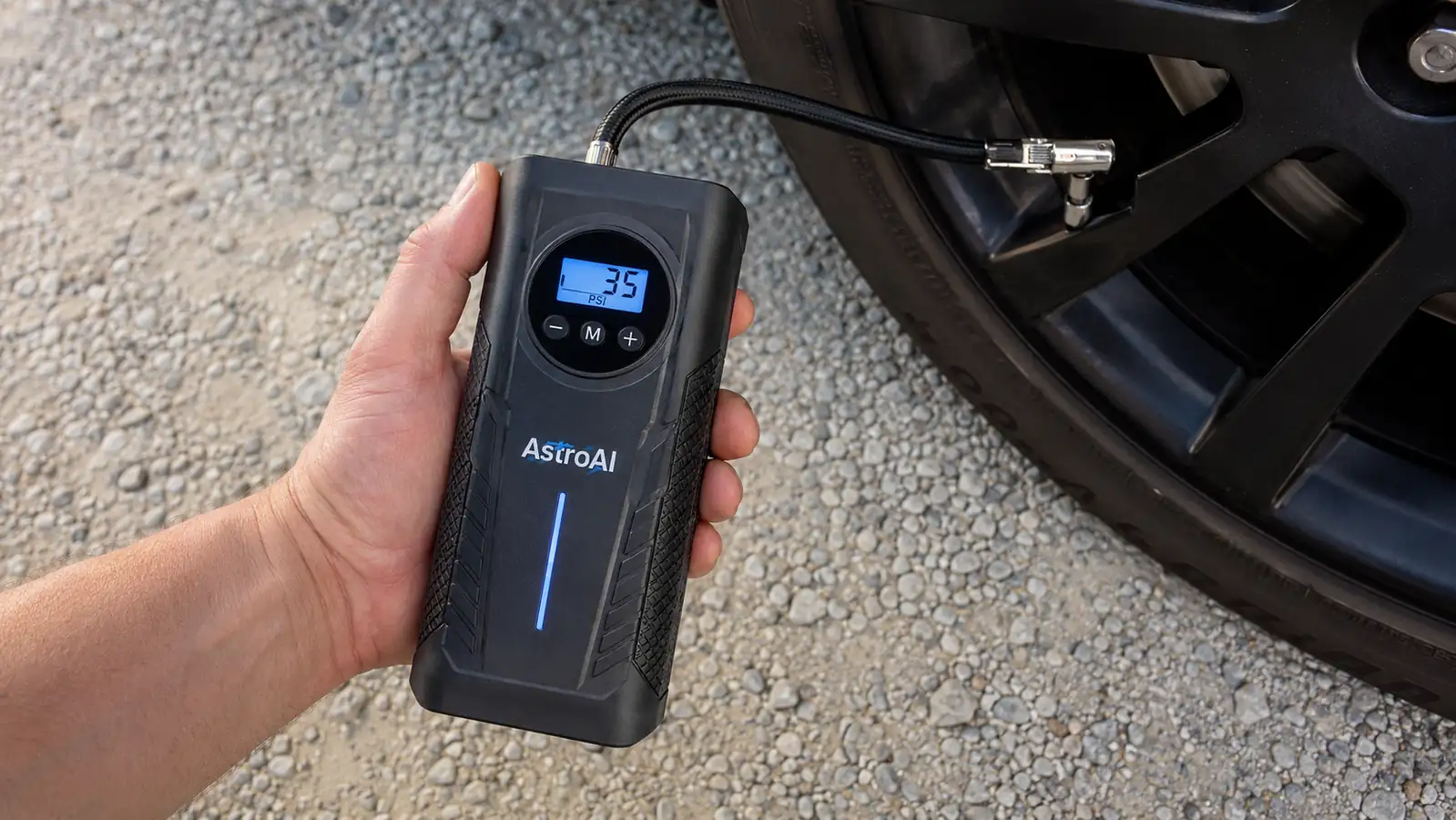
Where the AstroAI Inflator Wins
The biggest advantage is that it is never closed. It does not have hours, it does not run out of quarters, and it does not care if it is 2am on a state highway with the nearest town 30 miles off. I have used mine on a shoulder outside a rest area, in a hotel parking lot before an early departure, and once in our own driveway in Boise on a Sunday morning when Rennie noticed the rear tire looked a little soft before we headed out. None of those moments would have worked with a station pump, because in two of them there was no station anywhere nearby, and in the third one, driving to a station just to check a tire that might be fine felt like the wrong use of a morning.
The second advantage is the number itself. A digital gauge that reads to the whole PSI and holds steady removes the guessing that comes with a dented analog dial on a public pump. I check our tires against the pressure listed on the door jamb placard, not the number molded into the tire's sidewall, since the sidewall number is the tire's maximum rating, not the recommended pressure for our vehicle. The AstroAI makes that an exact process, set the target, watch the number climb, and it shuts off on its own once it hits that mark, which matters more than it sounds like it should when you are doing this at night with a flashlight in your other hand.
It also fits how we actually travel. It lives in the center console, weighs little enough that I never think about the extra load, and the 9.8 foot cord reaches every tire on the 4Runner without needing an extension. On longer road trips, I have started treating a pressure check the same way I treat checking oil, something to do before a trip and again partway through, and having the tool always in the vehicle is the only reason that habit stuck. I go through the full routine, including cold checks and what a slow leak actually looks like over a week, in my long-term AstroAI review.
Tired of guessing at a dented gas station gauge? See today's price on the AstroAI inflator.
It has run through a full season of temperature swings in our 4Runner and never once needed a coin or a working station to find.
Amazon Check Today's Price on Amazon →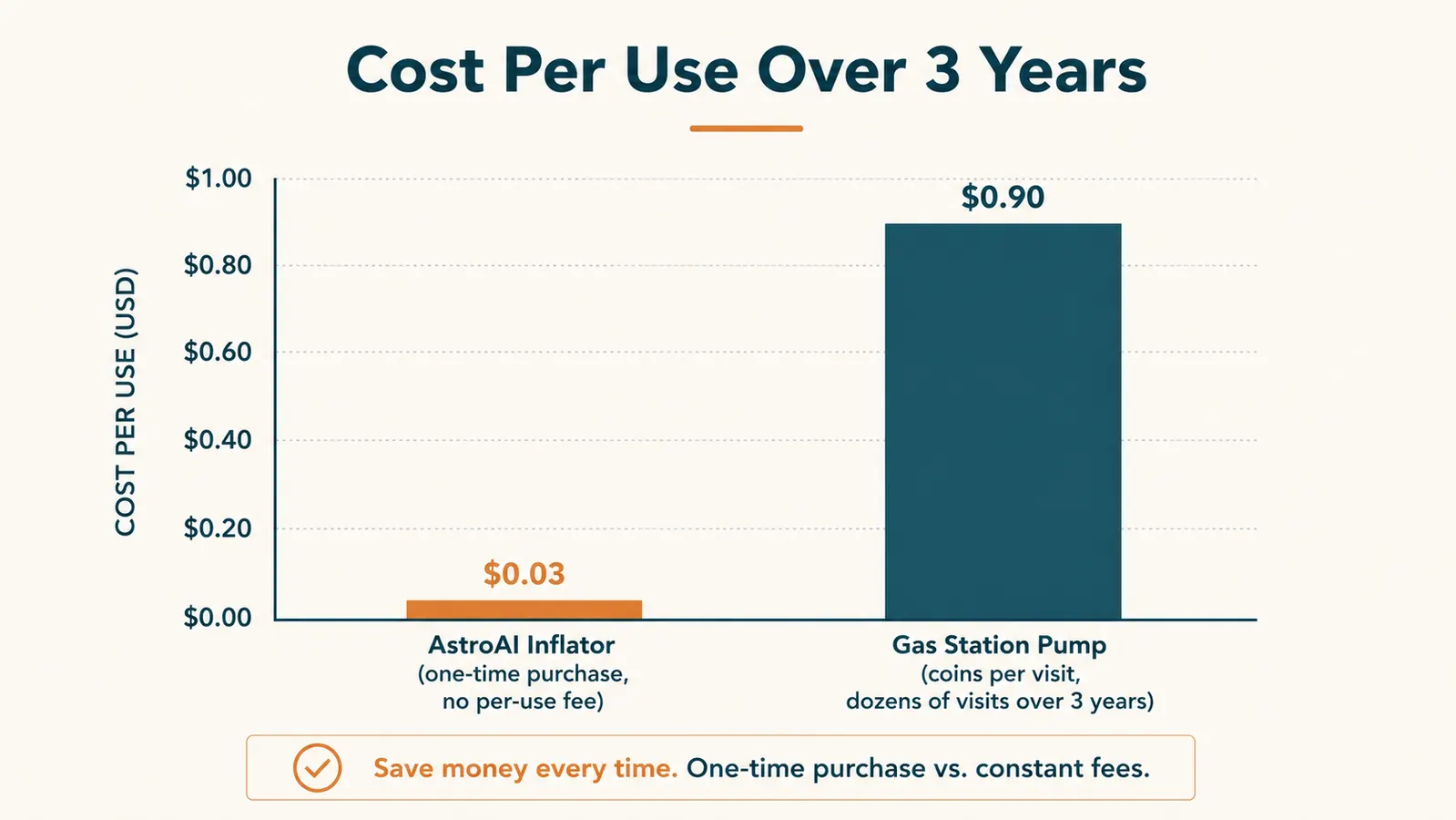
Where the Gas Station Pump Actually Wins
I want to be fair here, because a 12V portable inflator is not built to do everything a shop compressor does. If a tire has gone genuinely flat, not low, actually flat, a small inflator like the AstroAI is going to take a while and put real strain on itself trying to move that much air from zero. A station pump or a real shop compressor moves air faster and in far greater volume, and that raw airflow matters if you are trying to get a tire back up to driving pressure quickly rather than just topping off a tire that lost a few PSI over a cold week.
There is also the bead-seating problem, which nobody likes to talk about until it happens to them. If a tire has come off the rim, even partially, seating that bead back onto the wheel needs a fast, high-volume burst of air that a small 12V unit is not designed to deliver. That is a job for a shop compressor, not a glove box tool, and I would never suggest otherwise. If you are dealing with a fully flat tire or one that has slipped off the bead, get it to a shop or use a real compressor, and treat the portable inflator as the tool for routine pressure maintenance, not tire recovery.
The Safety Number That Actually Matters
Whichever tool you use, inflate to the number on the door jamb placard, not the maximum pressure stamped on the tire's sidewall. Those are two different numbers doing two different jobs, and mixing them up is one of the more common mistakes I see people make at a pump, station or portable. The placard number is what the vehicle manufacturer calculated for that specific tire size on that specific vehicle. The sidewall number is simply the tire's maximum rating, which is almost always higher than what your vehicle actually needs.
Check pressure cold, meaning before the vehicle has been driven that day or at least three hours after it last moved. Tires that have been driven build heat, and heat raises the pressure reading, so a check right after highway miles will read artificially high and can lead you to underfill once things cool back down. None of this is professional mechanical advice, it is simply the routine I follow, and if a tire looks damaged, is losing air fast, or you are unsure about a sidewall bulge or embedded object, get it looked at by someone qualified rather than relying on any pump, mine included, to solve a problem it was not built for.
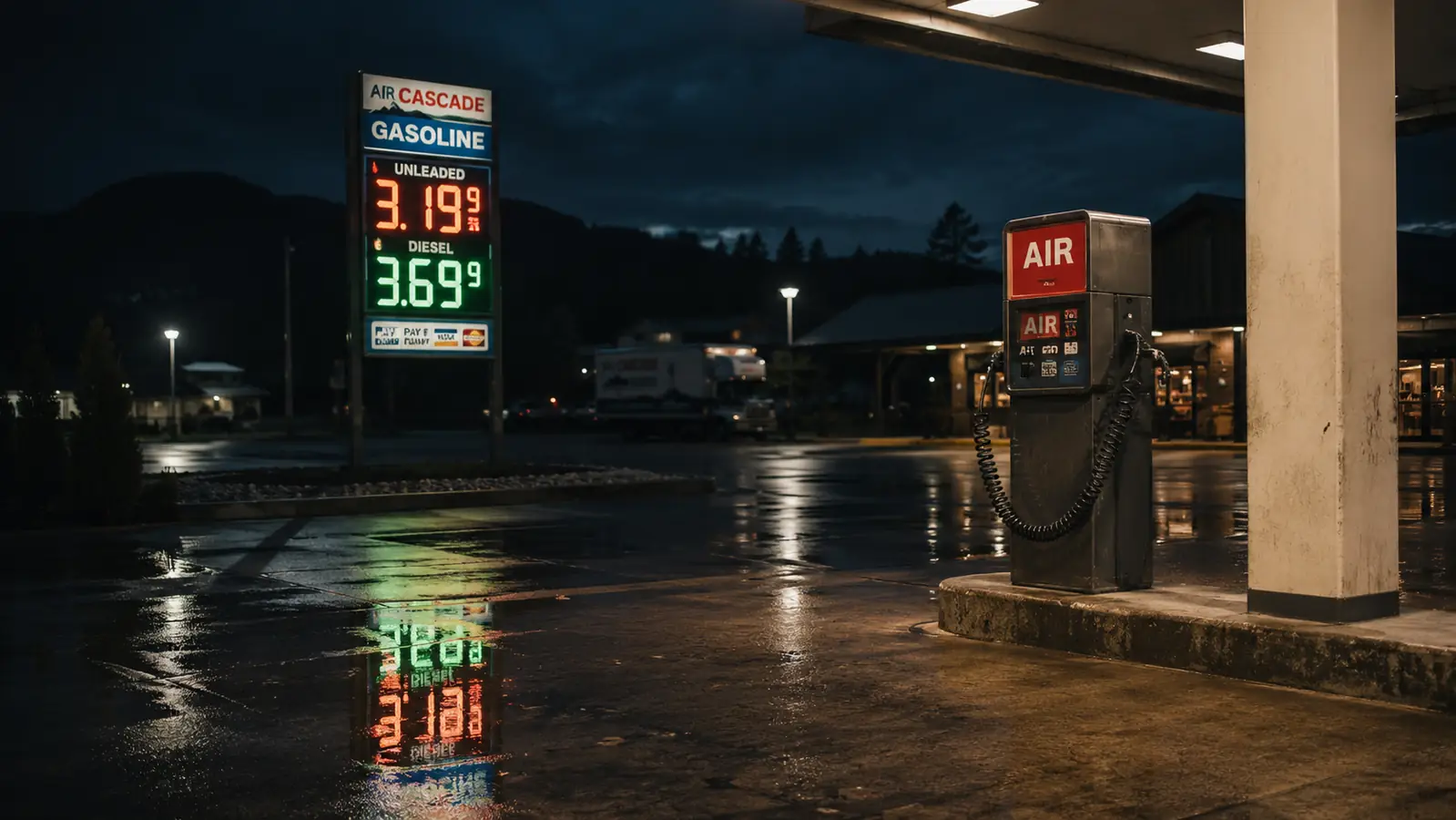
A gas station pump asks you to trust a dial you cannot verify. The AstroAI just tells you the number and lets you check it yourself.
Cost Per Use, Three Years In
I did not track every coin I have fed into a gas station pump over the years, but a rough count from recent trips puts me at a station air pump somewhere between 15 and 20 times a year, mostly for routine top-offs I now handle at home or on the shoulder instead. Some of those stations charge per use, and even at a modest amount per visit, that adds up over a season, and it adds up again the next season, and the one after that. The AstroAI is a single purchase, and after that the only ongoing cost is a trickle of power off the truck's own electrical system, the kind of draw you would not notice on a fuel bill.
The other cost that is harder to put a number on is time and detours. Every station stop for air is a small detour off your actual route, a search for a working pump, sometimes a second stop because the first one was broken. Over a season of regular road trips, those detours cost more real time than the two or three minutes it takes to plug in the AstroAI at the shoulder where you already stopped. I get into the exact numbers and the one thing that genuinely surprised me about long-term use in my honest AstroAI review.
Who Should Buy Which
If you drive long distances, road trip regularly, or just want to stop guessing at tire pressure between oil changes, the AstroAI is the tool that earns its keep, because it works on your schedule instead of a station's. If you are dealing with a tire that is actually flat, has come off the bead, or needs a fast high-volume fill, a shop compressor or a working station pump is genuinely the better tool for that specific job, and no portable inflator should be expected to replace it. The honest answer for most regular drivers is to own the AstroAI for routine checks and top-offs, and treat a real compressor as the backup for the rare day something goes seriously wrong.
Stop hoping the next station's pump actually works.
See current availability and pricing for the AstroAI 12V portable inflator before your next road trip.
Amazon Check Today's Price on Amazon →