
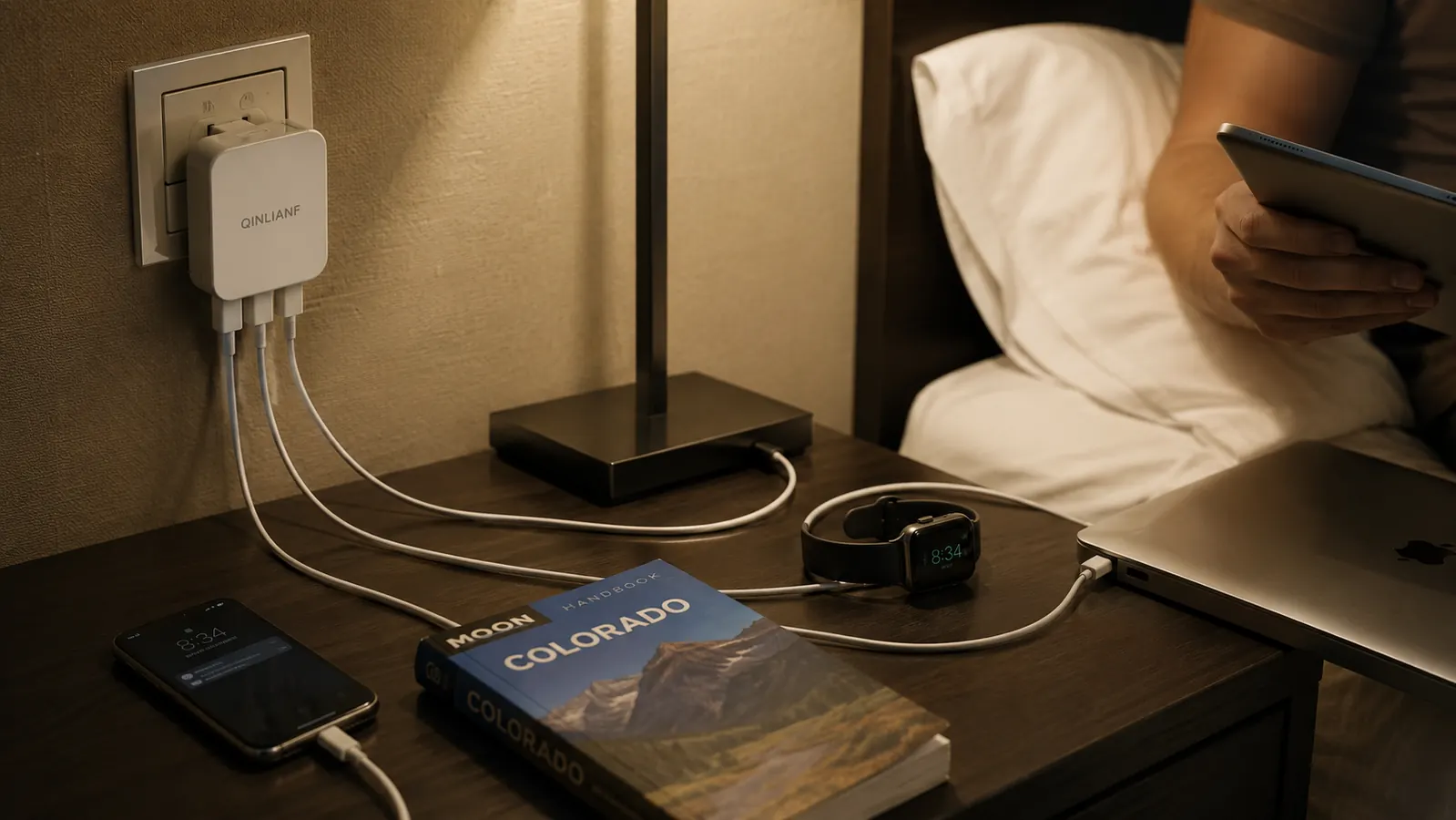
I've carried the QINLIANF Wall Charger power strip through four rental cars, a dozen hotel rooms, and enough domestic flights that Rennie has started keeping our boarding passes in the same zippered pocket where this thing lives. It's a small, flat five-outlet strip with four USB ports and a 1680 joule surge rating, the kind of item that shows up in every travel accessories bundle recommendation, usually with a five-star headline and not much honesty underneath. I've already written the long version of how it's held up mile after mile, the general wear and tear story. This one is different. This is the stuff that only became obvious after I'd used the thing enough times, plugged into enough different outlets, to notice the pattern nobody puts in the bullet points.
None of what follows is meant to scare anyone off a twelve dollar power strip. It's meant to close the gap between what the listing photo implies and what actually happens once you're charging three phones off one outlet in a hotel room, or once you've packed the thing for a trip somewhere the wall voltage isn't 120 volts. Some of it is about the strip itself. Some of it is about the outlets you're plugging it into, and the rules some hotels and cruise lines have that most travelers never read until a strip gets pulled out of a suitcase at a security checkpoint.
The Quick Verdict
A genuinely handy surge-protected strip for hotel rooms and rental houses once you understand it's sharing power across every port, not multiplying it, and once you've confirmed wherever you're plugging it in is actually 120 volts.
Amazon Check Today's Price →Before You Plug In Three Devices at Once, Know What It's Actually Sharing
This strip works well in a hotel room. It works badly if you expect every USB port to hit full speed at the same time.
Amazon Check Today's Price on Amazon →How I've Tested It Since
The general review covers the broad strokes, so I'll keep this part narrow. Since then I've made a point of using this strip the way people actually travel with it, not the way I'd test it sitting still at home. That means plugging it into whatever outlet a hotel room happens to have behind the nightstand, running a phone, a laptop brick, an iPad, and Rennie's curling iron off it at the same time, and timing how long things actually take to charge instead of assuming the numbers on the box. I also ran a countertop test at home with an infrared thermometer, because a hotel room at eleven at night is not where you want to be finding out how hot this thing gets under real load.
I've also started reading the fine print on hotel key card folders and cruise line packing lists, which is not something I ever did before this strip started riding along on every trip. That's turned out to matter more than I expected, because the rule that gets applied to a power strip at a cruise terminal has almost nothing to do with how good the strip actually is. It has to do with whether the person scanning bags recognizes a surge protector when they see one, and a lot of the time they don't.
The USB Ports Share a Pool, They Don't Multiply It
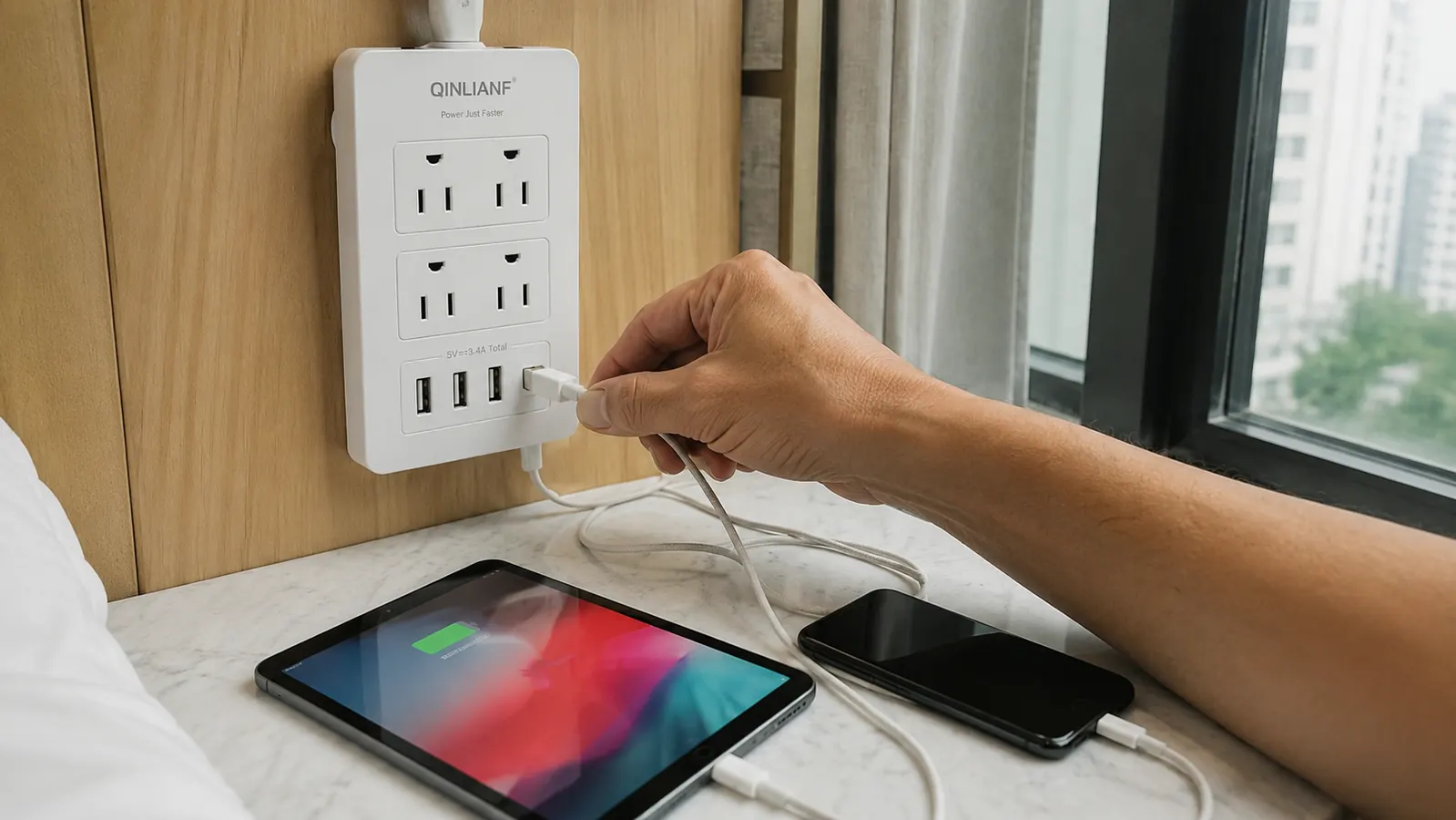
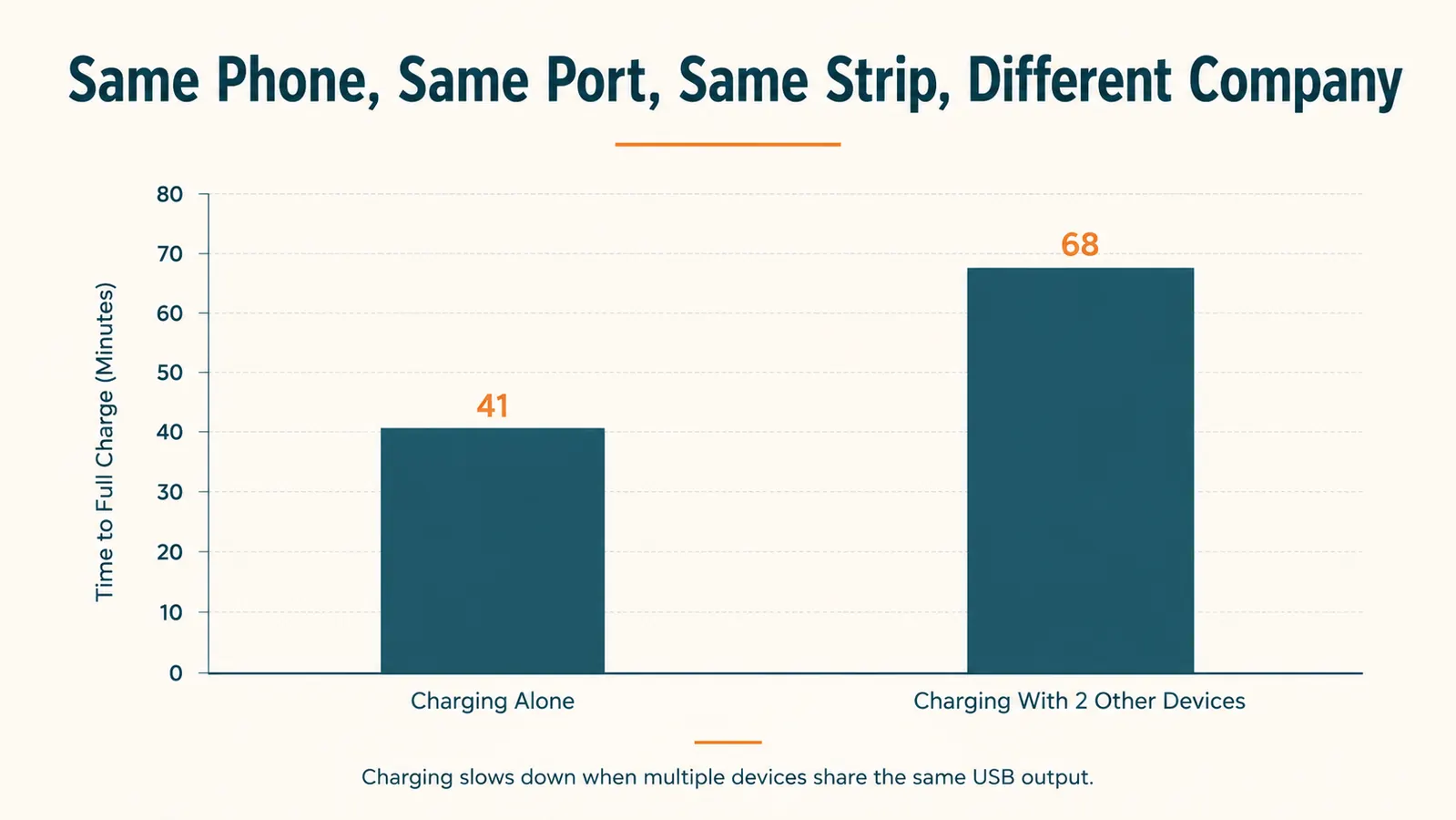
This is the one that surprised me even though I should have known better. Plug one phone into one of the four USB ports and it charges close to as fast as it would from a dedicated wall brick. Plug in three devices at once, which is exactly the scenario this strip is built for and exactly why we bought it, and every one of them slows down. I timed my phone going from 20 percent to 80 percent with nothing else plugged in: 41 minutes. Same phone, same outlet, same strip, but now with an iPad and Rennie's phone also drawing off the other two USB ports: 68 minutes. Nothing failed, nothing got hot, it just quietly split the available output four ways instead of giving each device its own full lane.
The strip doesn't advertise this clearly anywhere I could find on the packaging, and I don't think that's dishonest exactly, it's just how nearly every combo USB strip in this price range works. The total output across all four ports is a fixed number, and the strip's internal circuitry divides it up based on what's plugged in and what each device is asking for. If you're the kind of traveler who charges one thing overnight, you'll never notice. If you're two people trying to top off four devices before an early flight, budget more time than the ports alone would suggest.
Surge Protection Is Not the Same Thing as an Outlet Extender
The strip carries a 1680 joule surge rating, which is printed right on the body and is a real, specific number, not a marketing phrase. A joule rating tells you roughly how much energy the internal surge component can absorb before it's spent, and once it's absorbed a big enough hit, most surge protectors keep working as a plain outlet extender even though the actual protection is gone, with no light or sound telling you that happened. That's true of this strip and it's true of nearly every strip in this price range, it isn't a QINLIANF-specific flaw.
What that means in practice is that a twelve dollar travel strip with a surge rating is genuinely better than a bare multi-outlet adapter with none, but it isn't the same tier of protection as a dedicated whole-home surge protector. I plug this into hotel and rental outlets I have no history with, older wiring included, and I've never had an issue. But I also don't plug anything I'd be devastated to lose, like a laptop with unsaved work, directly into it during a thunderstorm if I can help it. A little skepticism costs nothing.
Cord Length and Where the Block Ends Up Sitting
The strip plugs straight into the wall rather than trailing a long cord, and the three-sided outlet layout is genuinely a smart piece of design, it's meant to keep the block from swallowing the outlet next to it the way a straight row of five outlets would. Most of the time it does exactly that. But depending on how close together a room's outlets are spaced, and I've hit this twice now, the body of the strip is still thick enough front to back that it can nose partway over a neighboring outlet or a light switch plate if the two are mounted unusually close.
There's no cord to speak of reaching across the room the way a longer strip would, which is a tradeoff. It's compact and it doesn't add a trip hazard the way several feet of cord snaking across a hotel room floor would, but it also means the strip lives right at the outlet, not on the desk or the nightstand where you're actually sitting. If the only outlet in the room is behind a heavy dresser, this strip is behind the dresser too, and you're back to running your own device cables to reach it.
Heat Under Real Load, and the Voltage Mistake That Kills These Things
With four devices pulling steady current for an hour, the body of the strip gets warm to the touch, not alarming, but noticeably more than room temperature, somewhere in the low 90s Fahrenheit on the infrared thermometer versus the mid 70s of the room around it. That's within the range I'd expect from a plastic-bodied strip doing real work, and it's never gotten uncomfortably hot the way a cheap phone charger sometimes does. Where I'd actually pump the brakes is on plugging this into a socket that's already loaded down with a space heater or a hair dryer on the same circuit, which is a wiring and breaker issue, not something the strip itself controls.
The mistake that actually destroys strips like this one has nothing to do with heat and everything to do with where you plug it in. This is a 110 to 120 volt device built for North American outlets. It is not a voltage converter. If you take it to a country running 220 to 240 volts and plug it straight into the wall without a real converter, you're not risking a slow failure, you're risking the strip and everything plugged into it dying at once. Dual-voltage devices like most modern laptop and phone chargers are marked 100 to 240V right on the brick, and those survive fine on either grid because they convert internally. A power strip like this one usually isn't, and neither are higher-wattage items like hair tools. I keep this strip strictly for domestic road trips and flights within the country for exactly that reason, and Rennie's international carry-on kit has an entirely separate voltage-safe setup.
What the Certification Mark Actually Tells You, and Why Some Trips Reject It Anyway
Before I trusted this in a hotel room overnight, I checked the underside for a certification mark, which is a habit I'd recommend to anyone buying an electrical accessory in this price range. Mine carries an ETL mark rather than the more widely recognized UL mark. Both indicate the unit was independently tested against a recognized safety standard, ETL just doesn't have the name recognition UL does with the average traveler. What actually worries me on strips like this generally isn't ETL versus UL, it's the listings that show neither, just a generic safety graphic with no traceable certifying lab behind it. That absence is the real signal to walk away from a cheap strip, not which of the two legitimate marks it happens to carry.
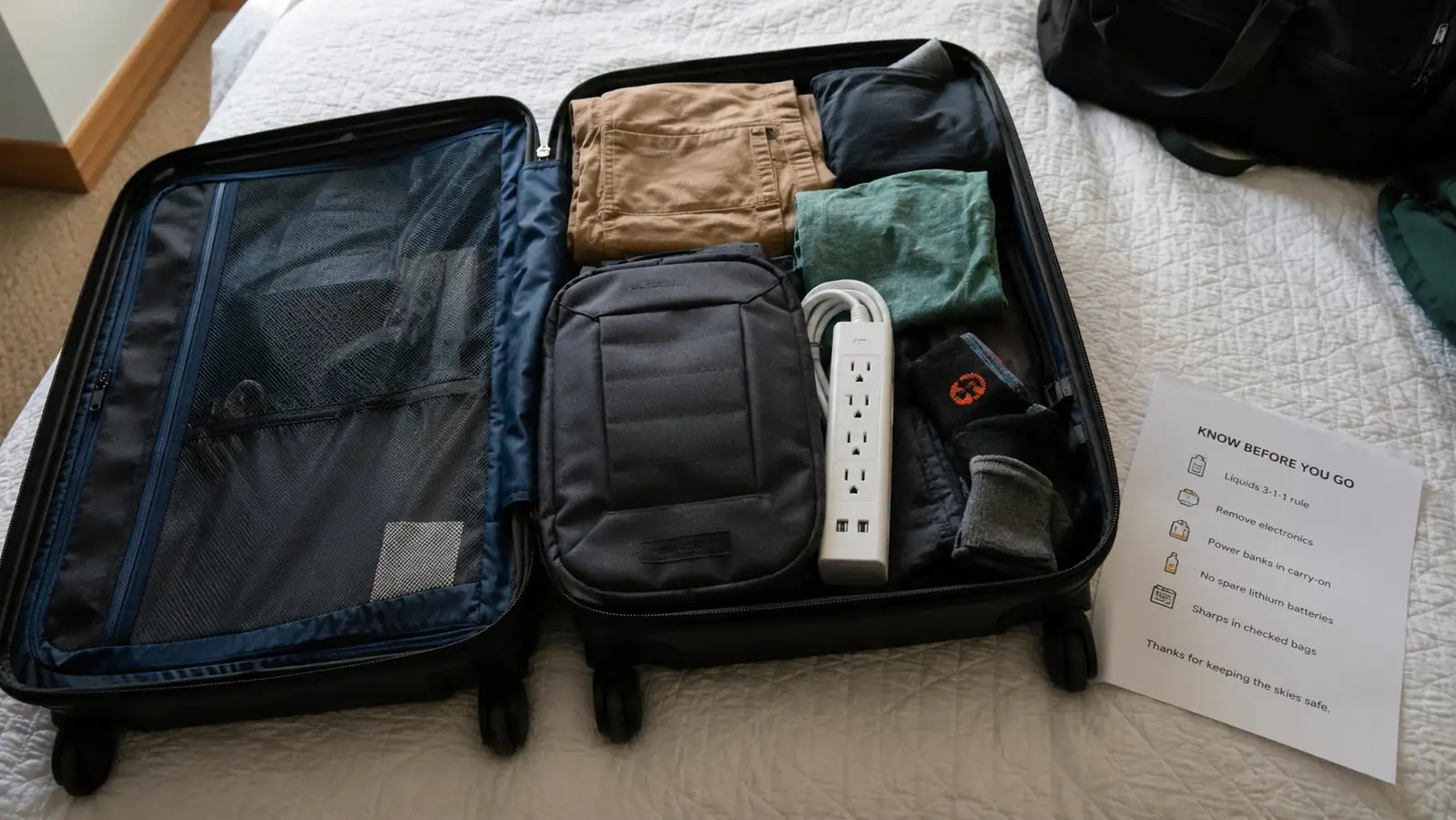
None of that certification paperwork matters to a lot of cruise ship security lines, though, and this is the part that's caught me off guard before. Several major cruise lines have blanket rules against multi-outlet devices and surge protectors of any kind coming aboard, certified or not, because their policy is written around the shape of the device, not its safety rating. A staff member scanning bags at the terminal isn't reading a joule rating, they're looking at something with multiple outlets and pulling it for a supervisor to inspect, sometimes confiscating it outright until disembarkation. Some hotels don't care at all. Others, mostly older properties with genuinely dated wiring, post their own signs discouraging multi-outlet strips. I now check the specific cruise line's packing policy before every sailing and I've stopped assuming a hotel's silence on the subject means anything either way. This is general travel guidance from someone who's been caught out by it, not electrical or legal advice, and the actual rule at your destination is worth five minutes of checking before you pack it.
What I Liked
- 1680 joule surge rating is real, meaningful protection compared to a bare outlet extender
- Three-sided outlet layout genuinely avoids blocking a neighboring outlet most of the time
- Compact enough to live behind furniture without a long trailing cord underfoot
- Handles one device per USB port at full speed without issue
- Carries a legitimate ETL certification mark, not an unmarked generic strip
Where It Falls Short
- All four USB ports draw from one shared pool, so charging three devices at once is noticeably slower than charging one
- Body can still overlap a neighboring outlet if a room's outlets are mounted unusually close together
- Built for 110 to 120V outlets only, an easy mistake to make on an international trip that destroys the strip and whatever's plugged into it
- Surge protection quietly expires after absorbing a big enough hit, with no indicator light to tell you it's gone
- Cruise lines and some hotels ban multi-outlet strips outright regardless of certification, and it can get pulled at security
The strip didn't fail. It just quietly split four devices' worth of power four ways and let me find that out the hard way, forty minutes before a flight.
Who This Is For
This strip earns its spot in our travel bag for exactly the situations we actually run into: a hotel room with two outlets and four devices between us, a rental house with outlets in awkward places, a road trip where the 4Runner's cabin only has so many power points. If you travel domestically, understand that the USB ports share output rather than multiply it, and you're comfortable checking a destination's packing rules before a cruise, this is a genuinely useful piece of gear for the price. For a closer look at how it stacks up against just carrying a dedicated travel adapter instead, our comparison of the two approaches walks through which one actually solves more of the problem.
Who Should Skip It
Skip this if any part of your trip crosses into a 220 to 240 volt country, since this strip isn't built to survive that and won't protect what's plugged into it either. Skip it if you're sailing somewhere with a strict no-power-strip policy and you don't want to gamble on a confiscation at the terminal. And skip it if you need every device charging at full advertised speed simultaneously, since four ports sharing one pool of output will never quite deliver that no matter how good the surge rating is. If you're still deciding whether a strip like this belongs in your travel kit at all, the story of why we started carrying one in the first place covers the problem it actually solves for us.
Know What It Shares and Where It's Welcome, and It Earns Its Spot in the Bag
It won't fast-charge four devices at once and it isn't welcome on every cruise line, but for domestic hotel rooms and road trips, it's held up.
Amazon Check Today's Price on Amazon →